Making a Flute from Prebored Blanks
Useful Tools and
Materials
A chisel
An exacto knife
A drill.
Small files
Titebond II wood glue by Franklin
A glue applicator like a small paint roller or a small foam
“brush”
About 8 pinch clamps
A swab to reach up into the flute to remove glue that
extrudes after clamping. A shotgun swab with a paper towel
attached works well.
Sandpaper in 60, 80, 100, 120, 150, 180 and 220 grits
Surform , or nice sharp plane for shaping. Other options
for shaping include lathe, router, carving knife, sandpaper
A few sturdy rubber bands
Nice but not necessary---Dremel with bullet-shaped grind
stone
An electronic tuner.
A Few Terms
Note: These terms
are Stellar terminology. Other makers may use other terms.
Head of
the flute--- the end of the flute nearest the mouth
Foot of
the flute---the end of the flute farthest from the mouth
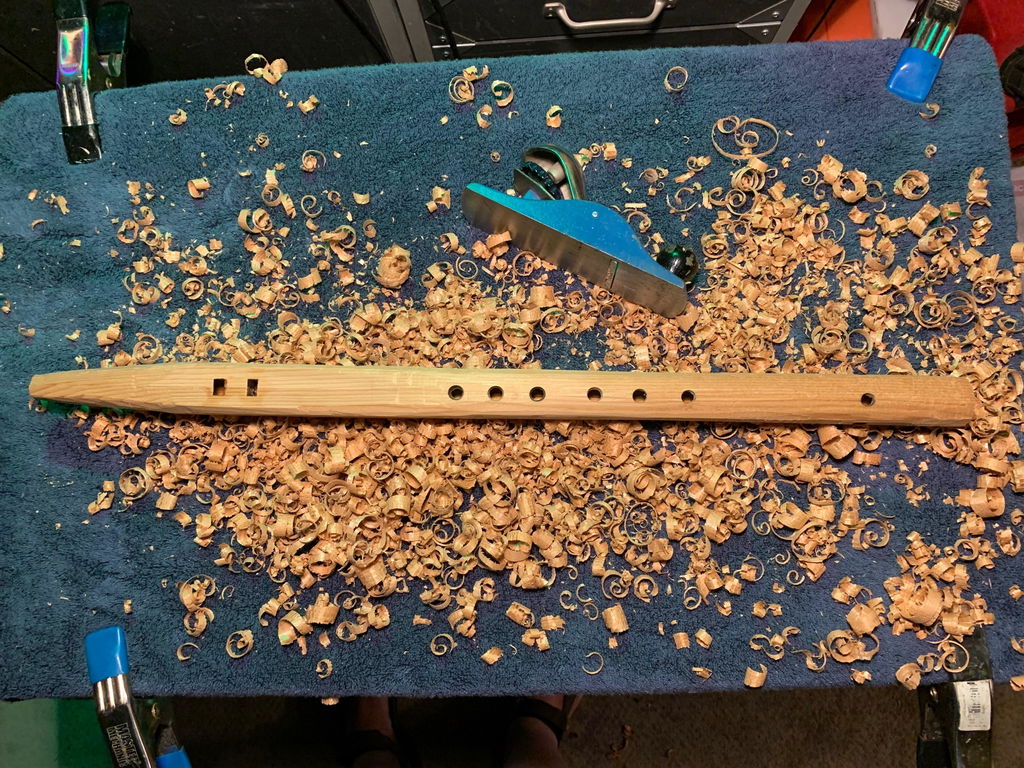
Fipple --
the two square holes at the head of the flute and on top of
the flute where the block sits. Called A and B here.
The ramp---the
bevel in the front wall of fipple hole A.
Block—the
removable piece on the top of the flute with the grooved
underside
Deck—the
flat area on top of the flute where the block sits
4 Direction holes—the
4 holes near the foot of the flute used in tuning
The Fundamental
note or fundamental tone—the note achieved when all
finger holes are covered.
Slow air chamber
---air chamber at the head of the flute, that is the same
diameter as the bore.
Flute
Diagram


Making the Fipple
Handy Tools: a
drill, a chisel, an exacto knife, small files, and sand
paper.
The fipple is an
important part of the flute. It is responsible, along with
the block for making the sound wave. Air comes out of hole
A, and when the block is positioned, it is blown over the
top of hole B.
The two square fipple
holes, A and B, are made before glue-up, and glue-up can be
done in two ways.
1. You can run the glue line on the top and bottom of
the flute so the fipple holes and finger holes are dissected
by the glue line.
2. Or you can run the glue line along the sides of the
flute.
Measure
Measure the width of the
groove on the underside of your flute block. It should be
7/16”. The width of the square fipple holes, A and B,
should be the same as the width of this groove in the
block. Tools that might come in handy for making the holes
are a drill, a chisel, an exacto knife, small files, and
sand paper. It is a good idea for the sharp edge of
the front square hole to be slightly blunt initially because
when the deck is sanded after glue up a sharp hole tends to
get longer and this can spoil the sound somewhat. The point
can be easily restored with a file later. Do as much as you
can before glue up. This is the most important part of the
flute. When you are done all parts of it should be
smooth.
If you use the top and
bottom glue-up method you will make half of each
fipple hole in each flute half so that when the flute is
glued up the holes are nearly complete. To lay out your
cuts place the two halves side by side. The touching sides
will be the top. The Head side of the front square hole
should begin about ¼” towards the foot from the round end of
the bore groove. Make a fine pencil line across both halves
there and another line ¼” further towards the foot. Draw an
angle across that edge on each half, leaving a blunt about
1/16” perpendicular to the length of the flute. The angle
can be about 45 degrees. With a sharp exacto
knife or razor blade cut down with a rocking motion on your
lines. Cleave that way a little, then clean out the bottom
between your cuts by angle cutting a little at a time. The
rear square hole can be the same as the front, but it is
much less critical. From time to time hold the two halves
together to check your work. You can measure or use the
block as a measuring tool checking for width. If you know
how, this operation can be done with a router or a Dremel
with a router base.
If you use the side glue
line method you will make the two square holes on one of the
flute blanks. You can drill two holes about ¼” and carve
them into the proper configuration. If you drill, be
careful not to tear out when punching through. Drill from
the inside with a Forstner bit while holding the blank
firmly against a piece of scrap wood.
We prefer the first way,
but one way is not better than the other. The glue line
never fails.
Glue
Up
Handy Tools: glue
applicator, about 8 pinch clamps, a shotgun swab, paper
towels
Make a swab before gluing
so you can wipe out the glue that extrudes inside the flute.
Coat the mating surfaces with a uniform film of glue (we use
Titebond II by Franklin). You can buy small touch up
rollers to apply the glue or a tiny brush. Clamp the halves
together paying attention to how things line up inside
the flute Allow light to shine in hole B and look
down the tube to make sure things are lined up. In internal
alignment is good it doesn’t matter if the outside is
slightly off. The ends of the flute should be even as well.
Check alignment again a minute or two later to make sure
things didn’t slide. Swab the extruded glue from the inside
of the front chamber. Don't worry about the rear chamber.
Glue that extrudes on the outside will sand off later. The
glue should be dry enough to remove the clamps in about an
hour if your shop is warm (70◦).
Shaping
Handy Tools: Surform
(Stanley makes them and all hardware stores should stock
them. Get the “6” pocket plane” ), rasp, router, or sharp
plane, sandpaper.
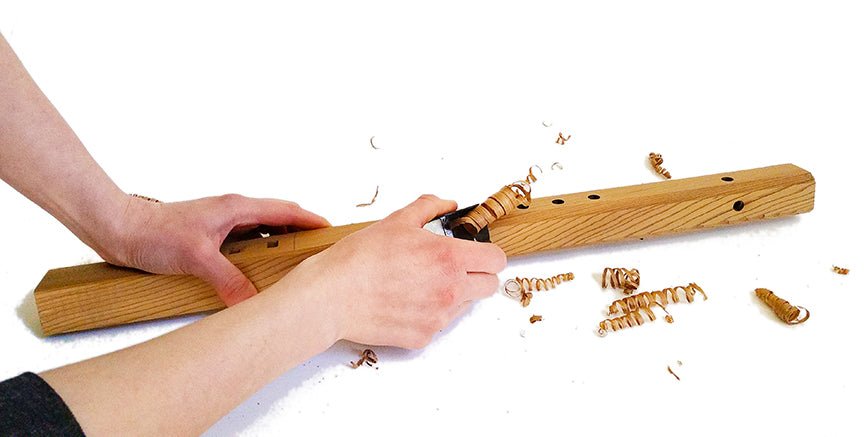
The flute can be rounded
or shaped before or after the finger holes have been
drilled.
The exterior may be a bit
out of alignment after glue up. Sanding or planing with a
very sharp plane (to avoid tearout) can even this out. The
"deck" where the block sets should be very flat and even.
Stroke the top of the flute (and the other three sides too)
while it is still square over sand paper on a very flat
surface to get the deck flat and smooth. Start out coarse
and end up fine with whatever you use for rounding. If you
don't have much experience work slowly and carefully and
don't get hurt! J
Drilling
Handy tools: a drill, hand
or electric
Using the measurements
provided drill finger holes about 1/8" to start with. Later
when you tune the flute you will enlarge them. Drill slowly
to avoid tearout inside the flute. Make sure they are
centered and in a straight line. Whatever key you choose be
sure to measure the hole locations from the rear of
hole B. Remember to drill four holes, called the
"four direction" holes, at the foot of the flute.
|
|
Key of A |
Key of G |
Key of F# |
Key of F |
|
First hole |
3-7/8" |
4-9/16" |
4-7/8" |
5-3/8" |
|
Second hole |
4-3/4" |
5-5/8" |
6" |
6-9/16" |
|
Third hole |
5-5/8" |
6-3/4" |
7-1/8" |
7-7/8" |
|
Fourth hole |
6-9/16"" |
7-7/8" |
8-7/16" |
9" |
|
Fifth hole |
7-7/16" |
8-7/8" |
9-1/2" |
10-1/4" |
|
Sixth hole |
8-3/8" |
10" |
10-5/8" |
11-1/2" |
|
4 "direction" holes |
12-1/2" |
14-7/16" |
15-3/8" |
16-3/8" |
|
End of flute cut |
15-3/4” |
17-1/2” |
18-1/2” |
19-1/8” |
Tuning
Handy tools: sturdy rubber
bands, drill or other rod (heated by torch), or Dremel with
bullet-shaped grind stone, electronic tuner. ½” dowel.
Tuning is accomplished by
enlarging the holes gradually. Start out drilling them
1/8”- 3/16”. It is best to use an electronic tuner. Music
stores sell them and they are not expensive. We tune at 70◦.
You should strive to tune with an even amount of breath
since louder is sharper.
Put the block on the
flute. Line it up carefully. Use a rubber band to hold it in
place. Cover the six finger holes and blow gently. You
should get a note that is lower than the fundamental tone
you are shooting for . The fundamental tone is the key
of your flute. For example, the key of G, or
the key of F#.
Enlarging the holes for
tuning can be done by using a hot drill or heated rod, or
you can do like we do and use a Dremel with a bullet shaped
grind stone—available where Dremels are sold. When first
used the grind stone slicks over from contact with wood.
From then on it burns with friction. Because it is tapered
it enlarges as it goes deeper. If you have a grindstone
dressing tool you can shape these stones so that you have a
variety of sizes.
Enlarging the Four Direction Holes
First enlarge the four
direction holes at the foot of the flute a little at a time
until you reach the desired fundamental tone. This is the
note your flute plays when all finger holes are covered. If
you are new at flute playing you can tape all six finger
holes closed to tune the fundamental. For the key of A this
note is A. For the key of G it’s G, etc.
Tuning the Other Holes
Enlarge the 6th
hole slowly with the other five closed to tune the next note
in the pentatonic scale for your key.
Next enlarge the 5th hole with the top four
(only) closed for the next note
Enlarge the 4th hole with top three closed to get
the next note.
Enlarge the 3rd hole with the top two closed. *
This note is not one of the pentatonic notes but should be
tuned because the flute is not limited to pentatonic
playing.
Then, close holes 1 and 3 (only) and enlarge the 2nd
for the next pentatonic note.
Enlarge hole Number 1 with only the 3rd hole
closed to tune the top note which is the octave of the
fundamental note.
Sanding the bore
After you have drilled or
enlarged finger holes it is necessary to sand the bore to
remove any wood fibers hanging down. Make a sanding rod by
gluing 80-120 grit sand paper to a 1.2” dowel.
Follow this chart to know the order
of the notes for your key.
* A non pentatonic note
Key of A: A
,C, D, E, (*F#)G, A
Key of F#:
F#, A, B, C#, (*D#), E ,F#
Key of G: G,
A#, C, D, (*E), F, G
Key of F:
F. G#, A#, C, (*D), D# ,F
Putting a Finish on your Flute
Handy Tool/ Materials:
2 “ diameter plastic plumbing pipe PVC or ABS
about 30”, cap to fit pipe, clear gloss polyurethane
(strongly recommended), paint thinner or naphtha, a lag
screw that fits the blow hole (5/16”?), some kind of swab to
wipe out the bore (a shotgun swab is what we use ), paper
towels, a stick (pencil or small screw driver) to use to
transfer the flute to the peg, a peg or nail in a board to
hang flute on to dry, 220 grit sandpaper
Here is a very important
thing to consider. The inside of the slow air chamber should
be well sealed. This part of the flute collects condensation
when played and the moisture will cause the inside wood to
expand. Because the outside doesn't expand, the resulting
tension can crack the flute. Because the flue holes, A and
B, are the weakest point, the crack will usually show up
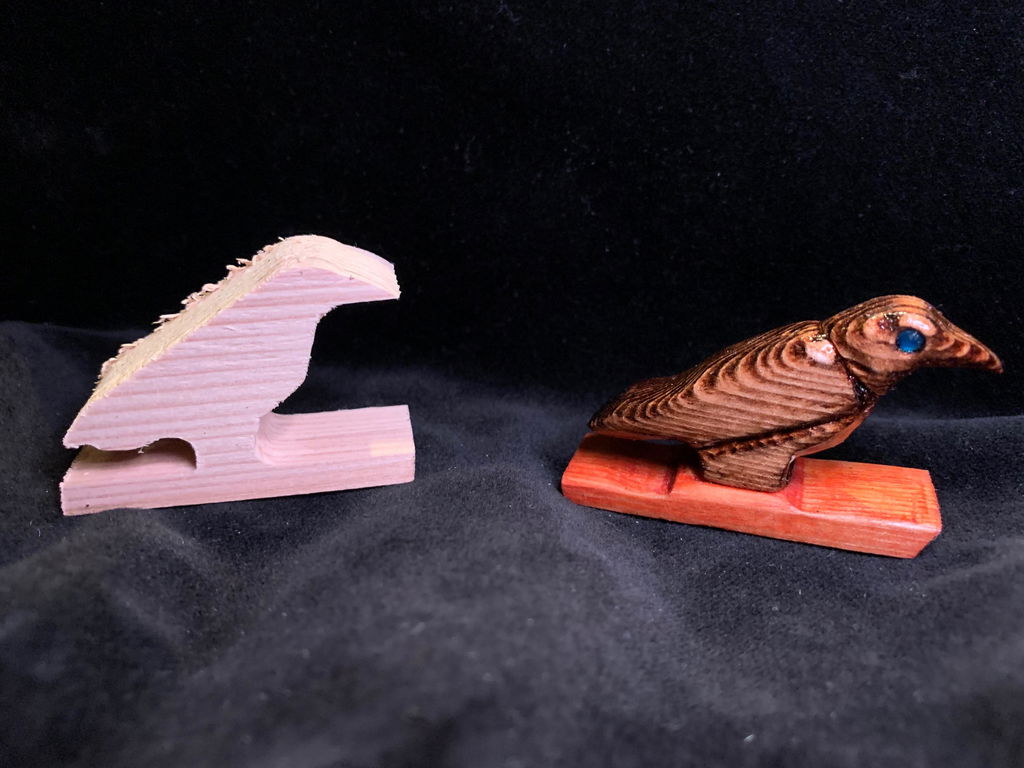
through them. The seal between the bird and the flute deck
will be loose, allowing air to escape. This has a bad effect
on the musical properties of the flute. It is fixable with a
little filler and light sanding, but a better approach is to
prevent this possible cracking in the first place by sealing
the inside of the slow air chamber.
Here’s a tip. You can lessen or eliminate condensation if
you can warm the flute prior to playing.
Dipping Method
Another important tip. You
can not apply an oil finish as described below. No oil will
provide the water protection needed in the slow air chamber.
Because wiping off excess oil is a necessary part of oil
finishing, the inside of the slow air chamber would become a
permanently sticky mess after multiple coats of un-wiped
oil.. If you want an oil finish you should still use
polyurethane inside the rear chamber of the flute. This can
be done by pouring poly into the rear square hole while the
blow hole is plugged. Pour it in and pour it out. Let it
drip until it quits dripping Let it dry overnight and repeat
three more times. Then shape the flute and finish the rest
any way you like.
One method of getting
every part of the flute inside and out well coated with
Polyurethane is to dip it. To do this we use
plastic plumbing pipe. Use a pipe 2 inches in diameter and
about 30”long. Fit it with the end cap. Secure it in an
upright position. The polyurethane plus thinner mineral
spirits or naphtha, can be poured into the pipe. We use 90%
polyurethane and 10% thinner (estimate!). Screw the lag
screw gently into the blow hole of the flute as a convenient
holder and plunge the flute completely into the poly,
coating it inside and out. Remove it from the varnish and
let it drip for a few minutes over the pipe. Hold it
slanted with the holes down so the liquid can drain from the
slow air chamber. Still holding it by the lag screw, swab
out the bore to prevent drips. While the swab rod is still
in the flute, wipe off all excess poly form the outside.
Remove the swab and put a rod through two of the direction
holes and unscrew the lag. Then place the flute blow hole
down on a nail so the last bit of poly can drip out. Have
the holes on the upside of the slant now so nothing can run
out there. Check for drips once more in a few minutes.
Allow to dry overnight.
After the flute is
completely dry sand it lightly with 220 grit sandpaper to
break the gloss. At this point you should remove 20% of the
poly from the tube and replace it with thinner. The next
three coats will use this thinner mix. Repeat the dipping
process three more times, sanding slightly between each
coat. When the final coat is dry you can rub it out with the
finest steel wool and apply a thin coat of bee’s wax.
Good Luck and enjoy your
flute!
SOME OF THE VARIABLES THAT AFFECT PITCH
Page 6
BORE VOLUME The
diameter and length of the front flute tube is a pitch
factor. Bigger is lower. Longer is lower. The location
and size of any finger holes have an effect of this
variable. If two flutes with different bore diameters are
in the same key the bigger one will have fingering closer to
the head closer together and generally be easier to play.
The voice of a flute in a given key will be affected
somewhat by the choice of bore size
BLOCK SHAPE A chimney block or a block that
leans out over the front fipple hole tends to lower pitch
FRONT FIPPLE HOLE SIZE Enlarging this hole
raises pitch of the flute. Increasing the length can
degrade or improve the voice (depending on your taste).
Increasing the width has less effect on voice.
FINGER HOLE LOCATION
Holes further from the head of the flute play lower in
pitch.
FINGER HOLE SIZE
Enlarging a finger hole raises the pitch of the note
controlled by that hole. The size of the hole is three
dimensional. It is more like a cylinder or cone than a
circle, so the thickness of the wall where the hole is, is a
size factor. A hole can be enlarged inside the flute to
raise pitch (sometimes called back filing). This method
leaves the hole looking the same from the outside. Removal
of wood from the inside nearest the head raises pitch more
than removal on the foot side.
AMBIENT AIR
TEMPERATURE Your flute will play higher in a warm
room and lower in a cold one. We tune at 70 degrees F.
whenever possible. We have a flute in our shop that we
consider to be gold standard for G. If the shop is not 70
degrees F. we play the “shop flute” for the tuner and see
where it registers. We then tune with that correction in
mind.
PLAYING VOLUME
If you play it louder you will be playing sharper.
OTHER ATMOSPHERIC
CONDITIONS It has always seemed to us that there
are other local conditions perhaps, atmospheric temperature
and humidity, that influence pitch but we don’t really know
what they are for sure.