
|
|
|
Back
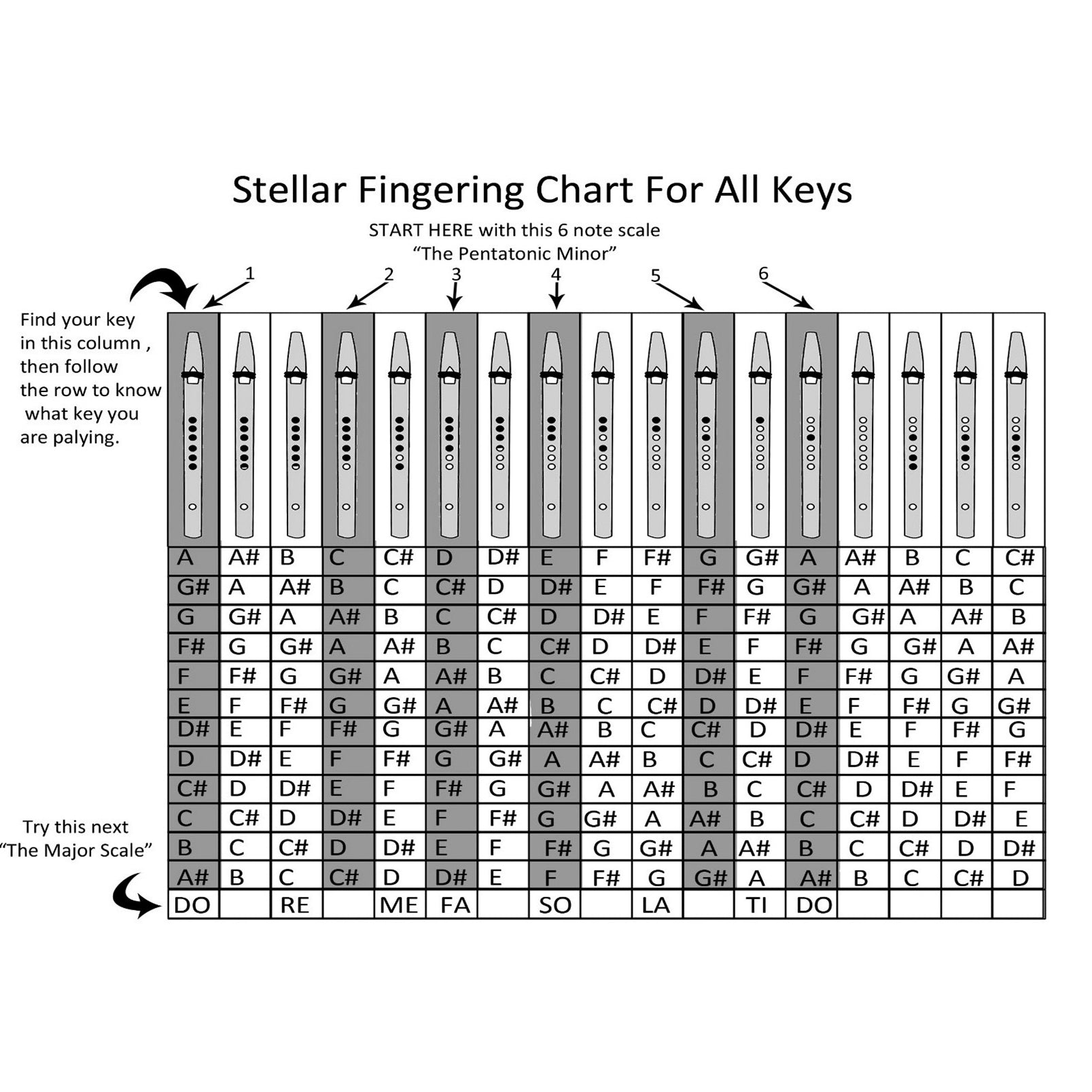
Click here to link to fingering chart
|
page 1
Makers'
Statement
Native people will
tell you that each tree has a spirit. After many
years of making wood flutes we have developed a
great respect for this spirit. From tree to
finished product each flute displays an individual
character which we call "voice". All woods are hand
-selected, and dried to the proper moisture content.
Each flute is turned on a lathe, bored, drilled, and
tuned. This process is the same for every flute we
make and yet no two flutes are ever exactly alike.
Each has its unique voice, its own sensitivities,
its own responsiveness. This aspect of mystery is
what has kept flute making interesting and
challenging. It's what has kept us on our toes,
kept our work careful and true.
Tom ,Erika, Matt, Lily Stewart & Gordon Jefferson
|
|
page 2
LEARNING TO
PLAY
Adjusting Your
Mind
If you have some experience playing a musical
instrument it’s probably best to set this knowledge
aside for a while. The Native American flute has
something to say to you. If you listen for it as a
novice you will notice it sooner and with more
clarity.
If you are new to the flute you need to get out from
under any notion that you are not musical.
Pretend if you need to that you might be
musical. We hope this doesn’t seem silly or
superficial to you because it is an important part
of getting started.
We suggest that you get off by yourself for these
beginning practice sessions and it will be helpful
to face a mirror. You are going to train your
fingers to cover the holes tightly and it may help
to watch what you are doing at first. Don’t begin
until you have at least ten minutes to spare.
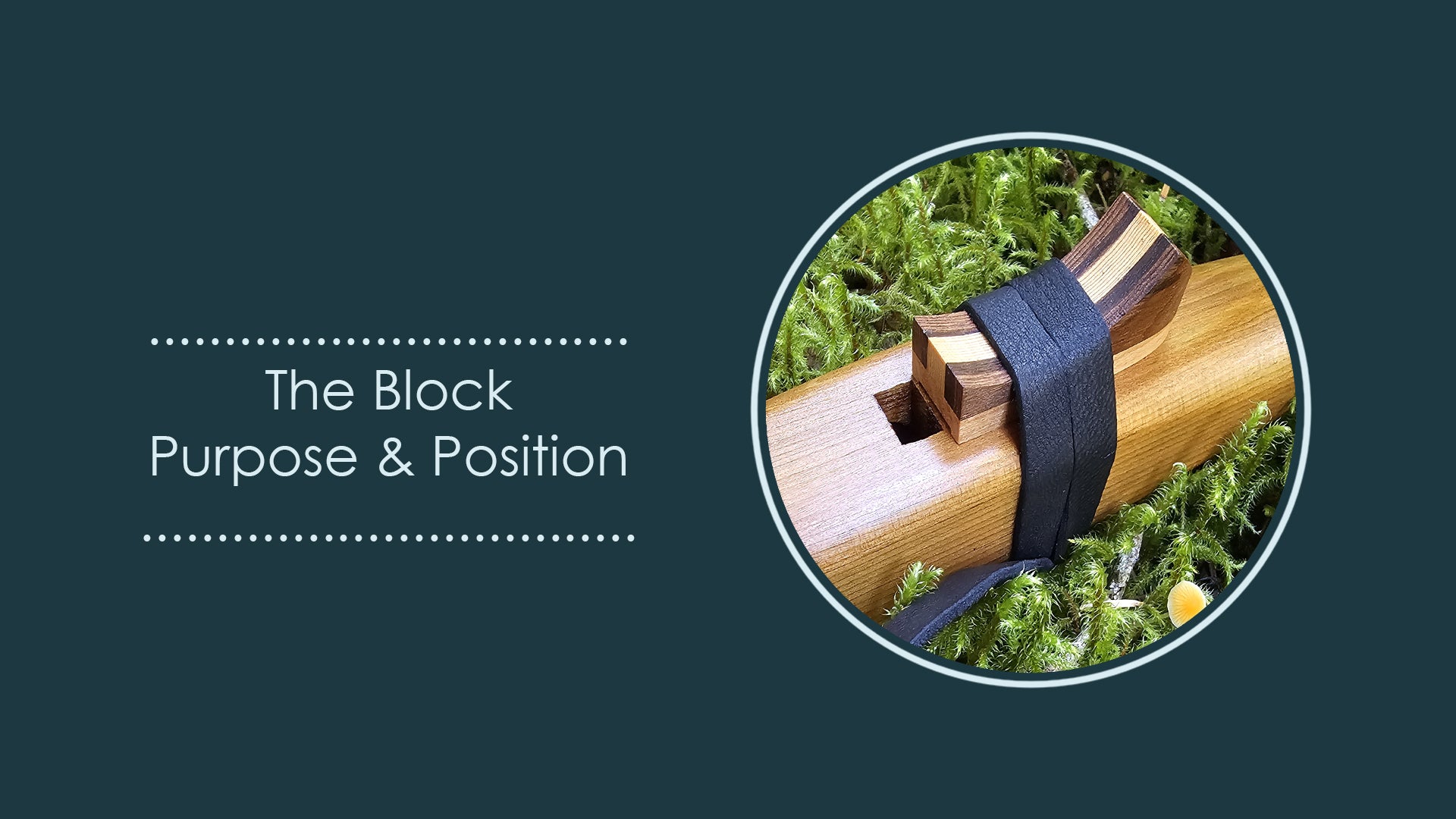
ADJUSTING THE BLOCK
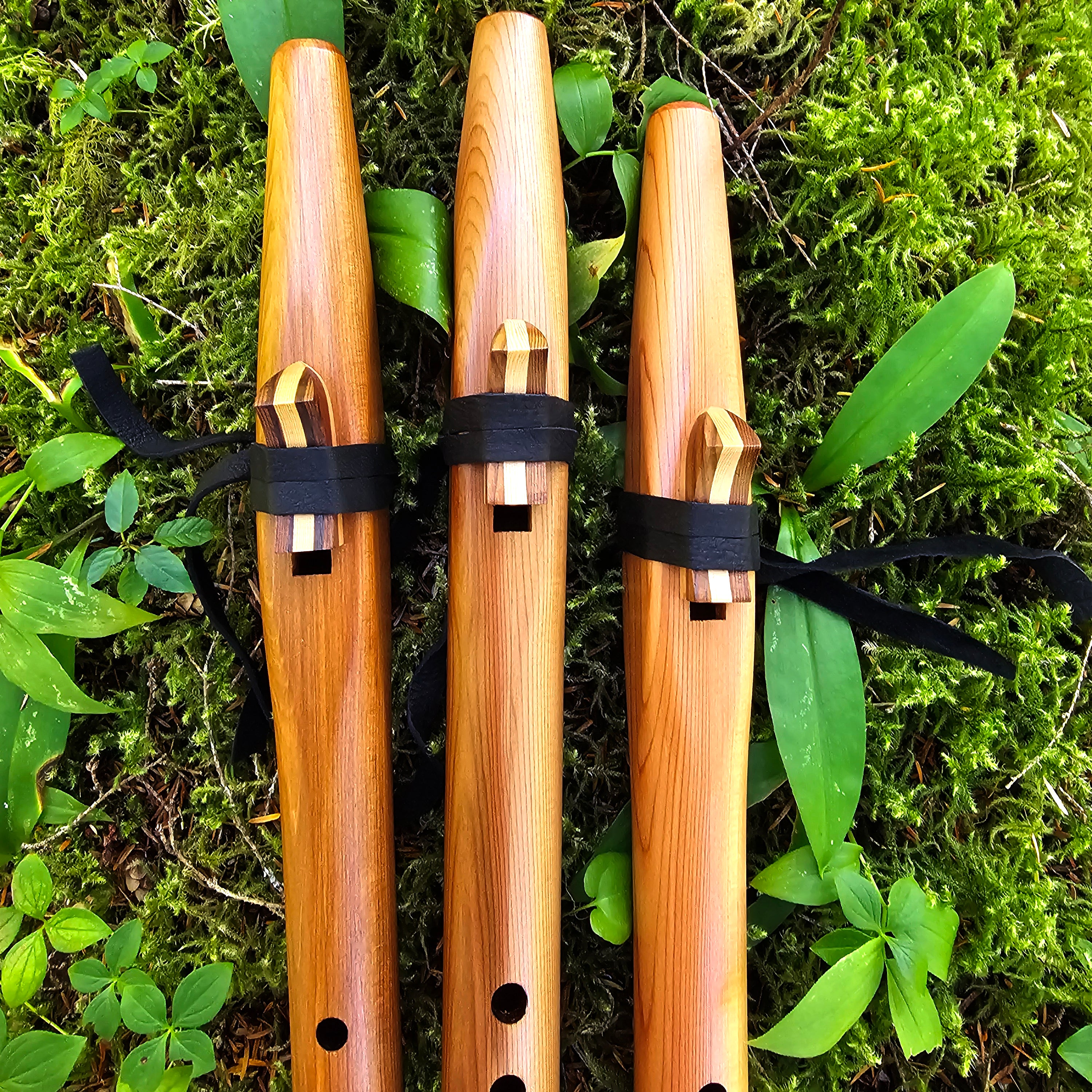
On top of the flute at the mouth end there are two
square holes. The block (often called the bird or
fetish) is placed over the hole nearest the mouth
end. It shouldn't cover any part of the other hole.
Center it over this hole and tie it to the top of
the flute by wrapping the leather strap over the
block and around the flute twice. The two ends of
the leather strap should now hang under the flute.
Tie them in a single knot. This is the type of knot
that is step one in tying your shoelaces. You will
need to tighten this knot from time to time and
should be able to do so by just tugging the ends of
the leather.
Check it Again
Just to be sure you understand what we're talking
about, the hole nearest the finger holes should be
totally visible, the other hole, totally covered by
the block. When the block is positioned just right
give the leather a final tightening. Hold the flute
out in front of you and check to see that the slot
on the under side of the bird is exactly lined up
with the first hole. Also check to see that in
tightening the block you didn’t tilted it to one
side or the other. It should be sitting flat on the
flat top, or deck, of the flute.
The leather strap should be tight enough to keep the
block stable during playing, but it might need to be
repositioned slightly after taking it out of a flute
bag, or if you bump it accidentally. |
|
page
3
While talking about the block, here’s an important
point. You must never remove it by dragging it off
the flute, leather strap and all. This can cause
damage or wear to the most important and delicate
part of the flute.
Basic Fingering and Scaling
OK. The bird and your mind are both adjusted and you
are alone in front of a mirror.
You are ready to train your fingers to cover the six
finger holes. To explain the next step we will
arbitrarily number the holes 1,2,3,4,5,6, with 6
being the hole furthest from your mouth. Now you'll
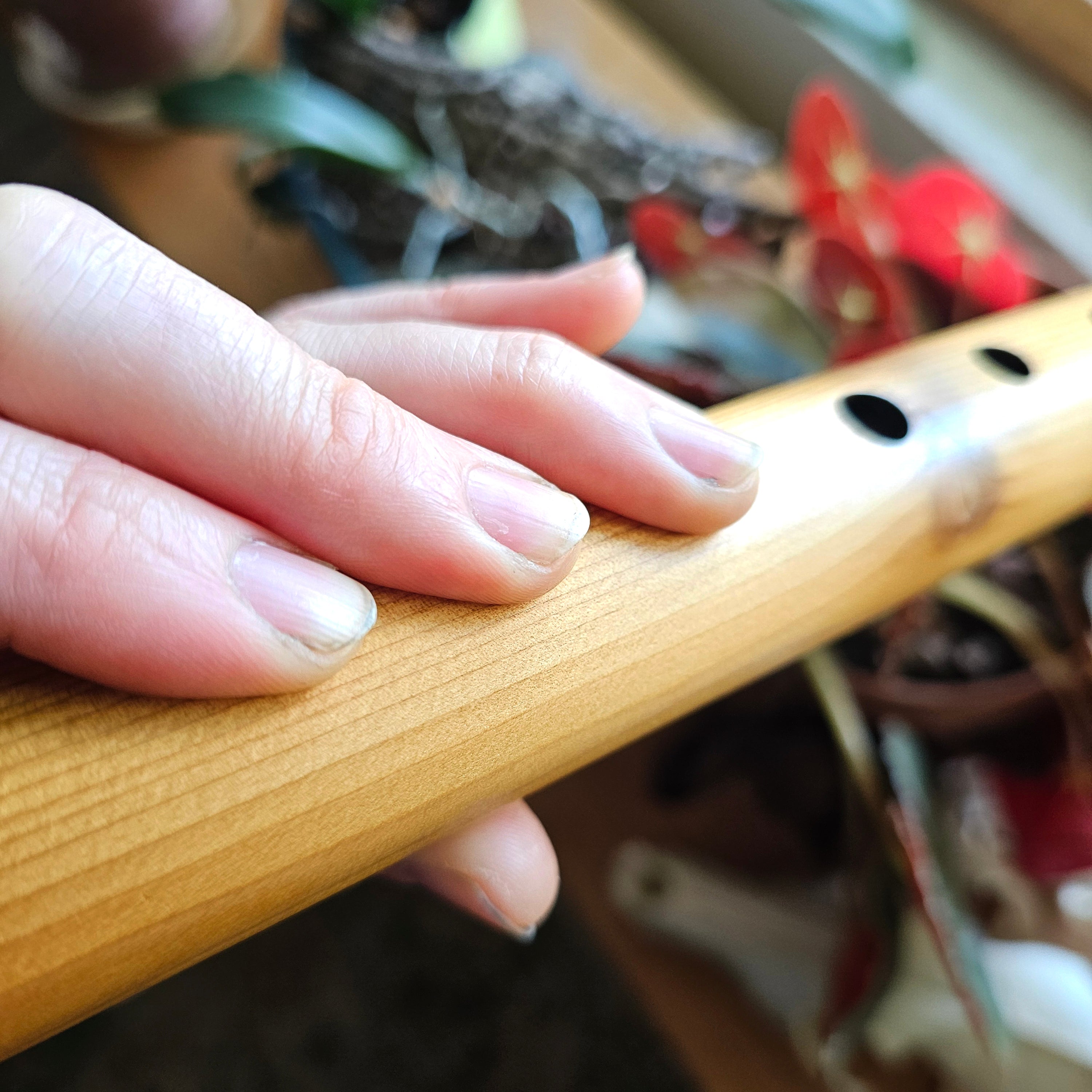
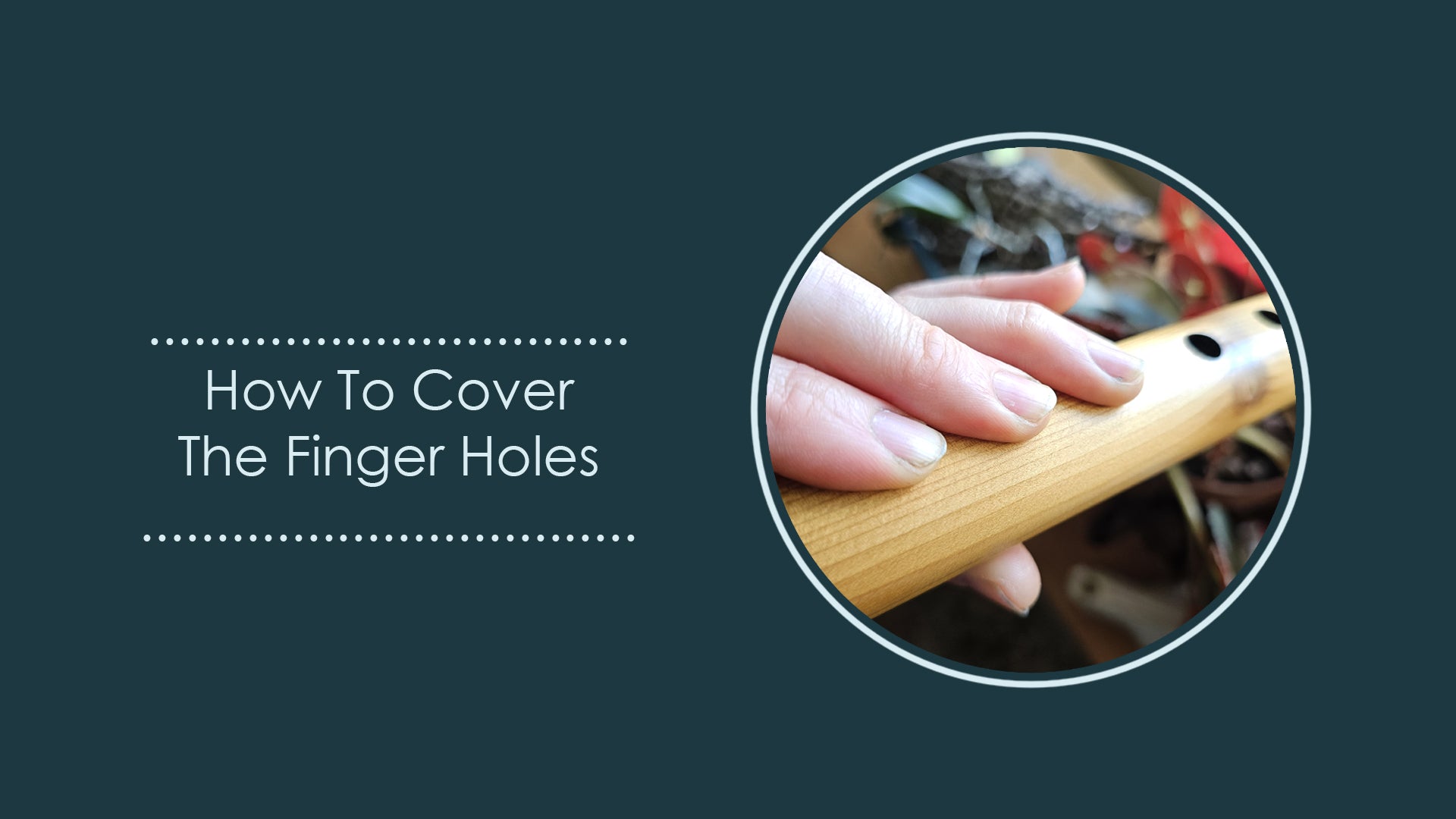
cover holes 1,2,3 with the fingers of one hand, and
holes 4,5,6 with the fingers of the other. When
doing this don't arch your fingers the way you would
for piano playing. Instead, keep your fingers
fairly straight and use the pads of your fingers to
cover the holes.
The
Fundamental
When you have all the holes covered blow gently.
You should get the lowest note your flute can
produce, which is called the "fundamental" note. If
you blow too hard you will get that note one octave
higher and it won’t sound nice.
Incidentally, this lowest note is the note that
determines the "key" of your flute. If you
purchased a flute in the key of mid G, this lowest
note is mid G.
This fundamental note is the most difficult note to
play. Each of the six fingers must tightly seal its
hole. One tiny air leak will ruin the note. If you
are sure the holes are covered and you still aren't
getting a nice fundamental tone check the block
again. If it is too far forward or not centered the
note will jump to a higher octave. Keep with it and
you will get it. If your fingers have never done
this before they may feel that the stretch is too
great, but being fingers they will learn.
Keep the Third
Hole Closed
When you can play the fundamental note, begin moving
up the scale by removing fingers one at a time –
6,5,4,2,1. Hole 3 stays closed.
When hole number 3 is the only hole closed you are
one octave higher than the fundamental note. Now go
back in reverse order, covering holes 1,2,4,5,6.
Remember to blow gently. This instrument is as
gentle as it is simple.
Repeat this scale until it is easy to play. It may
take you an hour or two to get to this point, and
you may not feel like doing more than ten minutes at
a time. Don't get frustrated. |
page 4
THE BASIC
PENTATONIC (five note) SCALE
You have now learned to play
the pentatonic scale. This is the basic five- note
scale of the Native American flute. It is by no
means the only scale that this flute will play, but
the flute features this five-note scale and it is
the easiest scale to learn. Once you've learned the
pentatonic scale you will discover something
wonderful. You can't go wrong with these five
notes. They can be played in any combination and
they will sound great together.
Soon enough you will be able to
improvise with these five notes. Try playing them in
different orders, and songs will create themselves.
It’s exciting to wonder where these songs came from.
The Rest of the Notes
You are not limited to the five
notes in the basic scale. We have included a
fingering chart, which shows how to play the other
notes in the chromatic scale. Some of these notes
are achieved by partially covering one of the holes,
called half-holing. This takes a little practice.
You will find there is often more than one fingering
for a note, and several notes can be overblown
(blowing harder than usual to force the note an
octave higher). We recommend that at first you
stick to the five notes the flute was designed to
feature before you begin to use the other notes and
methods.
Technique
Here are some other techniques
that will make your playing more interesting. You
can play tremolo by quivering your breath
from your diaphragm. It is the same muscle action
used in singing a tremolo. You can toot instead of
blowing. This is called tonguing. You can tap
notes repeatedly with your fingers to create
staccato. Try rolling an R or trilling while
blowing. |
|
page 5
Watering up
As you improve you will play
for longer periods of time, and you will find that
condensation forms in the mouth section of the
flute. This eventually finds its way up into the
block slot and your music will sputter. This happens
because the flute is cooler than your breath, and
your breath contains water vapor, which condenses on
the cool surface. It is a good idea to keep the
flute warm, if possible, to minimize condensation.
Put it under a light, or if you are going to play
outdoors carry it under your coat to warm it up
before playing.
When condensation forms hold
the flute to your mouth in such a way that you can
blow hard under the block. Then hold the flute by
the far end and sling the water out. This is risky,
though, since if you’re not careful you might fling
your flute, as well as the water, across the room –
or you might spray your audience with water and they
might not understand that it is only
water. It is also OK to remove the block to dry off
the wet places. Watering becomes less of a
problem as you acquire more flutes, and are able to
put the damp flute aside and play a different one.
TAKING CARE OF
YOUR FLUTE
When you are not playing the
flute try to remember to keep it in a soft case or
bag. Flutes, especially ones made of cedar, are
easily dented. If you want your flute to have a
weathered look, ignore this advice. But be good to
your block. The slotted underside of the block and
two square holes are the most important parts of the
flute.
Avoid temperature and humidity
extremes as much as possible. Don’t leave your
flute on the dashboard or rear window of your car
where the sun could overheat it. Don’t play it in
the shower with the water on. Don’t set it on the
couch, or on your car seat either where someone
might sit on it. Don’t ask your dog to fetch it for
you. |
|
Page 6
Stellar flutes are sealed inside and out with 4
coats of polyurethane for moisture protection. This
is the best water sealant available and it helps to
avoid cracking, which can result from the watering
just mentioned. A Stellar flute can actually be
washed, even submersed in water as long as it is not
allowed to stay wet afterward.
Troubleshooting
If the instrument suddenly
sounds different, or if it acquires a buzz or hiss,
or it loses loudness, look at the block location
first. If the block has not been moved, take it off
and look at the groove on the under side. If
something is there which shouldn’t be, clean it off
with a toothpick or your fingernail. Examine the
rest of the flute by allowing a light source to
illuminate the inside. Look straight into the
square holes and finger holes and view down the bore
while shinning a light through these holes. If you
discover a speck of foreign material in one of the
holes or in the bore sometimes it can simply be
blown away. But it you have to remove a more
stubborn fleck, be especially careful in the area of
the second square hole. This area and the underside
of the bird are very important and should not be
altered or scratched.
A Beautiful Gift
There is one more thing we'd
like to say before turning you over to a lifetime of
flute playing enjoyment. Please keep in mind where
this instrument originated. America’s first people
gave the Native American flute to the world. In so
doing they have given us all the gift of a beautiful
instrument and all the health, healing and joy this
instrument can provide. They have also given us a
means to heal some of the wrongs of the past by
deepening our understanding of their cultures. We,
as flute makers, are grateful.
Enjoy your flute
|
|
Page 7
Making a Flute
Instructions for Kit Buyers
Here are a few tips on creating
your flute. The flute as it comes is playable. The
bird-to-be can be tied down and placed so that the
groove end is just flush with the mouth side end of
the front flue hole. You can follow the
instructions on playing. It feels very awkward as a
square flute, but it plays.
As to the final shape, that is
entirely up to you as long as you don't change the
parts marked in pencil. It is Ok to sand these
areas enough to remove the pencil marks with fine
(220) grit paper with a flat rigid backing like a
sanding block. You have my permission to shape it
like we do, or you can do your own or someone else'
thing.
Here is a very important thing
to consider. The inside of the mouth end chamber
should be well sealed. This part of the flute
collects condensation when played and the moisture
will cause the inside wood to expand. Because the
outside doesn't expand, the resulting tension can
crack the flute. Because the flue hole is the
weakest point, the crack will usually show up as a
failed glue line. This usually partially restores
when the flute dries out but the seal between the
bird and the flute deck will be loose, allowing air
to escape. This has a bad effect on the musical
properties of the flute. It is fixable with a
little filler and light sanding, but you can prevent
it by sealing the inside. Our finished flutes are
finished inside out entirely with multiple coats of
polyurethane, which we think is the best sealer.
One way to do this is to dip
the whole flute in your sealant. You can also plug
the blow hole and full up the chamber with whatever
you choose and then pour it back out and stand the
flute up to drip and dry. This technique if best if
you plan to use a different finish like Danish or
Tung Oil on the outside of the flute. These hand
rubbed oil finishes look great, but oil cannot be
used effectively as a sealer. We recommend several
coats of polyurethane on the inside of the rear
chamber. You can make a dip tube with a section
of poly or abs pipe with one end capped. After
dipping let the flute drip out, hanging it somewhere
to avoid a mess. When it quits dripping it should
be wiped off to insure that drips are gone.
(Continued ) |
|
Page 8
(Kit making continued)
It should also be noted that while it is OK to
completely round the flute, you should not remove
any wood from the area of the finger holes. When it
gets round don’t go any further or you will change
the tuning.
Shaping the flute can be done with a sharp block
plane or carving and sanding tools. A band or
scroll saw can be used to rough out the block
(bird). Dremels, spindle sanders, and belt sanders
can also be used. The finished bird needs to be
lashed to the flute with leather or some other
strand and if your bird has a low spot or hole above
the grooved bottom this makes things fit better.
We should also mention that the inside bore on the
mouth end of the flute is the same 7/8" diameter,
and extends to 2-1/2" from the end. Be careful not
to break through if you taper that end. |
|
Page 9
What is a flute Circle?
A flute circle is a group of people who meet
regularly to share flute fun. Circles are for
players at any level from beginner to virtuoso.
Maybe you need help with flute technique, or maybe
you just want to share the fun of group playing.
There are many reason to belong to a flute circle.
If you'd like to join a circle check the web site of
the International Native American Flute Association
(INAFA) to see if there's a group near you. If
not, maybe you should start one...
www.inafa.org |
|
Page 10
Products
Standards
In the keys of C, A, G, F#, F, and E
Call for or visit our website to find out what's
available.
Basics
Mid-range keys: C, A, G, F# and F
Western Red Cedar only
Pre-tuned Flute Kits
In the keys of C, A, G, F# and F
Pre-bored Flute Blanks
Template for mid-range A, G, F, F#
Western Red Cedar, Alder and Cherry
Drone Kits
In the keys of C, A, G, F# and F
Drones
Call for or visit our website to find out what's
available.
Middle Eastern Flutes
Call for or visit our website to find out what's
available.
|
|
Page 11
Tom & Lily Stewart
(Shelton, WA)
support@stellarflutes.com
Matt Stewart
(Edmonds, WA)
matthewstewart@comcast.net
Mailing Address:
E-2030 Phillips Lake Loop
Shelton, Washington, 98584
Call to Place Order
Tom & Erika Stewart
(Shelton, WA)
TOLL FREE:
1-888-427-8850
Matt Stewart
(Edmonds, WA)
1-425-744-0199
Place an order online
www.stellarflutes.com
|
|
|
|